
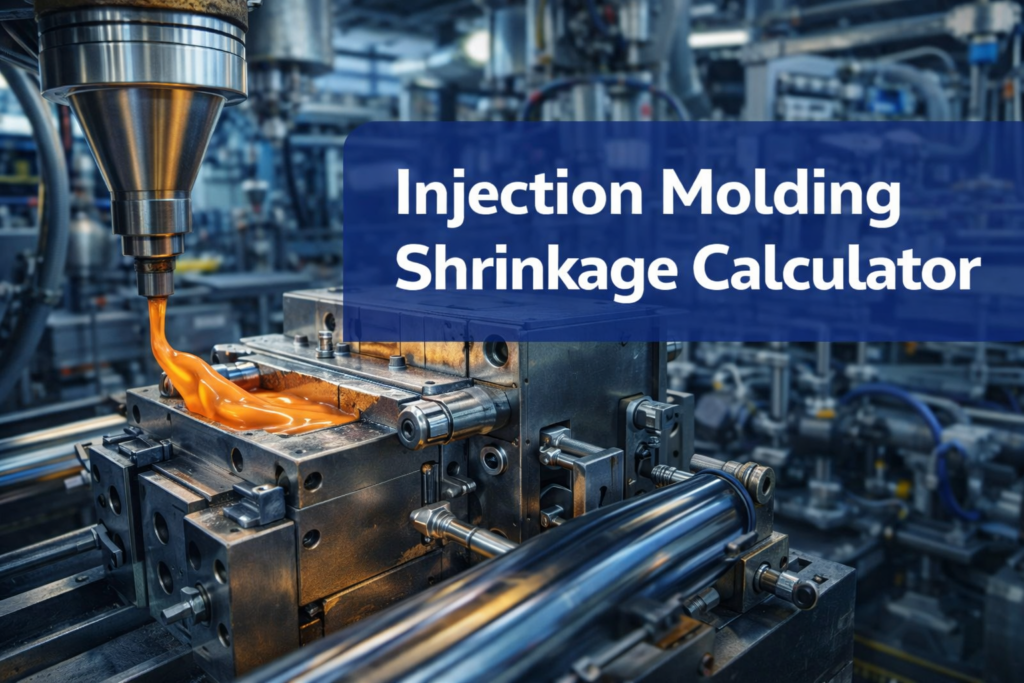
Injection Molding Shrinkage Calculator
Calculate mold size based on part size and material shrinkage rate.
How to Calculate Mold Cavity Size
Follow these steps to estimate accurate cavity dimensions:
- Enter your target part size (final product dimension)
- Select the appropriate plastic material
- Adjust the shrinkage rate if needed
- Click Calculate
- Instantly get the required mold cavity size
This calculator helps engineers quickly determine cavity dimensions during the early design stage, reducing design errors and improving production accuracy.
Injection Molding Shrinkage Formula
The standard formula used to calculate mold size is:
Mold Size = Part Size / (1 − Shrinkage Rate)
Where:
- Part Size = desired final product dimension
- Shrinkage Rate = material shrinkage percentage (converted to decimal)
- Mold Size = required mold cavity dimension
This calculator automates the process and helps you quickly determine accurate mold dimensions.
Plastic Shrinkage Rates Chart
| Material | Type | Shrinkage (%) | Notes |
|---|---|---|---|
| ABS | Amorphous | 0.4 – 0.7 | Good dimensional stability |
| ABS/PC | Amorphous blend | 0.5 – 0.8 | Improved strength |
| PMMA (Acrylic) | Amorphous | 0.2 – 0.6 | High transparency |
| CAB | Amorphous | 0.3 – 0.5 | Low shrinkage |
| PS | Amorphous | 0.3 – 0.7 | Low cost |
| SAN | Amorphous | 0.4 – 0.7 | Good chemical resistance |
| PC | Amorphous | 0.5 – 0.7 | High impact resistance |
Semi-Crystalline Plastics
| Material | Type | Shrinkage (%) | Notes |
|---|---|---|---|
| PP (Homopolymer) | Semi-crystalline | 1.5 – 2.5 | High shrinkage |
| PP (Copolymer) | Semi-crystalline | 1.0 – 2.0 | Better impact resistance |
| HDPE | Semi-crystalline | 2.0 – 4.0 | Very high shrinkage |
| LDPE | Semi-crystalline | 2.0 – 5.0 | Flexible |
| Nylon 6 | Semi-crystalline | 1.0 – 2.0 | Moisture sensitive |
| Nylon 6/6 | Semi-crystalline | 1.0 – 1.8 | Strong, durable |
| Nylon 11 | Semi-crystalline | 0.8 – 1.5 | Flexible |
| Nylon 12 | Semi-crystalline | 0.8 – 1.5 | Low moisture absorption |
| POM (Acetal) | Semi-crystalline | 1.5 – 2.5 | High precision parts |
| PBT | Semi-crystalline | 1.5 – 2.5 | Electrical components |
| PET | Semi-crystalline | 0.2 – 0.5 | Stable |
| PEEK | Semi-crystalline | 1.0 – 1.5 | High-performance |
Filled / Reinforced Plastics
| Material | Type | Shrinkage (%) | Notes |
|---|---|---|---|
| Nylon 6 (30% GF) | Glass-filled | 0.2 – 0.5 | Low shrinkage |
| Nylon 6/6 (33% GF) | Glass-filled | 0.2 – 0.6 | High stiffness |
| PP (30% GF) | Glass-filled | 0.3 – 0.7 | Reduced shrinkage |
| PP (30% Talc) | Mineral-filled | 0.8 – 1.2 | Improved stability |
| PS (30% GF) | Glass-filled | 0.1 – 0.3 | Very low shrinkage |
| SAN (30% GF) | Glass-filled | 0.1 – 0.3 | High precision |
Elastomers
| Material | Type | Shrinkage (%) | Notes |
|---|---|---|---|
| TPE | Elastomer | 1.5 – 3.0 | Flexible |
| TPU | Elastomer | 0.8 – 1.5 | High elasticity |
| Silicone | Elastomer | 2.0 – 4.0 | High temperature resistance |
What Is Injection Molding Shrinkage?
Injection molding shrinkage refers to the reduction in size of a plastic part as it cools and solidifies after being injected into a mold. When molten plastic is injected into the mold cavity, it occupies a larger volume. As it cools, the material contracts, resulting in a final part that is smaller than the mold cavity.
Shrinkage is a normal and unavoidable part of the injection molding process. However, if not properly accounted for, it can lead to dimensional inaccuracies and product defects.
Why Shrinkage Matters in Injection Molding
Shrinkage directly affects the final dimensions and quality of molded parts. If the shrinkage rate is not properly considered during mold design, it may result in:
- Parts that do not meet dimensional tolerances
- Assembly issues (parts too tight or too loose)
- Warping or deformation
- Reduced product quality and increased rejection rates
For precision components such as electronic housings, tools, or mechanical parts, even small shrinkage deviations can cause significant problems.
Factors Affecting Plastic Shrinkage
Shrinkage is influenced by multiple factors beyond just material type:
- Material properties – crystalline vs amorphous plastics
- Wall thickness – thicker sections shrink more
- Mold temperature – higher temperature can increase shrinkage
- Cooling time – insufficient cooling leads to deformation
- Injection pressure – affects material packing and density
Understanding these variables helps improve accuracy and reduce defects.
How to Reduce Injection Molding Shrinkage
While shrinkage cannot be eliminated, it can be controlled and minimized:
- Optimize wall thickness for uniform cooling
- Use materials with lower shrinkage rates
- Adjust mold temperature and cooling system
- Increase packing pressure during injection
- Improve mold design and gate positioning
These methods help improve dimensional stability and product consistency.
Applications of Shrinkage Calculation
Shrinkage calculation is essential in many industries:
- Injection mold design
- Precision plastic components
- Consumer electronics housings
- Tool manufacturing
- Automotive plastic parts
Accurate shrinkage estimation ensures better product performance and fewer production issues.
Get Professional Injection Molding Support
If you need precise mold design or custom plastic parts, Livepoint Tooling’s team can help you optimize shrinkage and improve product accuracy.
We support:
- Custom mold design
- Material selection guidance
- Precision manufacturing
- Bulk production
👉 Contact us today to get expert support for your project.