

Use Our Free Cavity Pressure Calculator
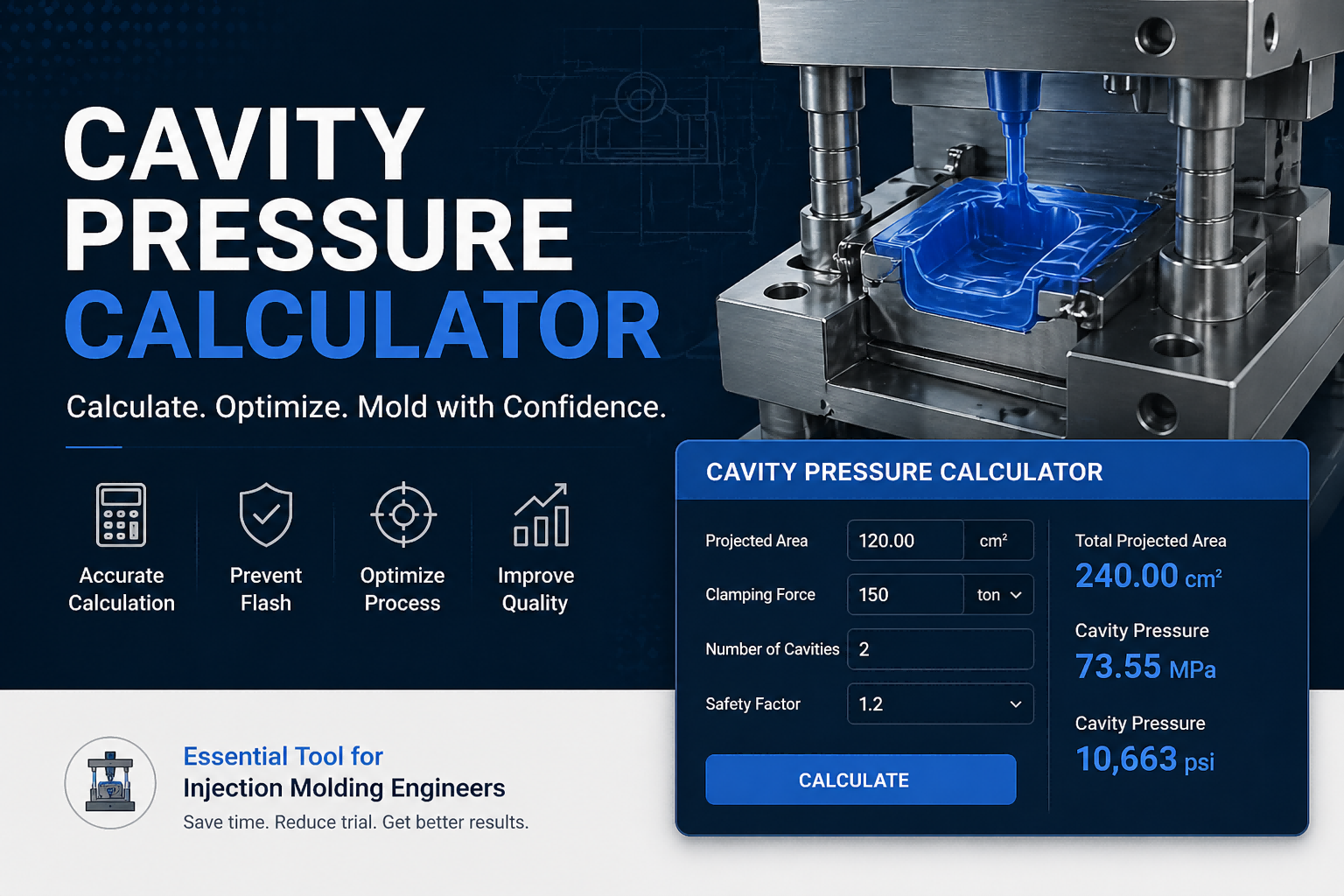
Use the calculator above to estimate cavity pressure for your next injection molding project.
If you need support on mold design, pressure optimization, or manufacturability review, feel free to contact our engineering team.
What Is a Cavity Pressure Calculator?
A Cavity Pressure Calculator is a practical tool used in injection molding to estimate the pressure inside the mold cavity during the filling and packing stages.
By calculating cavity pressure based on part projected area, clamping force, and cavity quantity, engineers can:
- Prevent flash defects
- Improve dimensional consistency
- Optimize packing pressure
- Verify clamp tonnage requirements
- Support mold and process design decisions
Rather than relying solely on trial-and-error, a cavity pressure calculator provides a faster and more scientific starting point.
How to Calculate Cavity Pressure
The basic cavity pressure formula is:
P=FAP=\frac{F}{A}
Where:
- P = Cavity Pressure
- F = Clamping Force
- A = Total Projected Area
For multi-cavity molds:
Atotal=Apart×NA_{total}=A_{part}\times N
Where:
- Apart = Projected area per part
- N = Number of cavities
Safety factors (typically 10–30%) are often added for practical molding conditions.
Key Inputs in a Cavity Pressure Calculator
Projected Area
Projected area is the total area of the part and runner system viewed in the mold opening direction.
Accurate projected area is critical because even small errors can significantly affect pressure estimates.
Clamping Force
Machine tonnage determines how much pressure can be contained before flash occurs.
Typical units include:
- Metric Tons
- kN
- lbf
Number of Cavities
More cavities increase total projected area and affect pressure requirements.
Safety Factor
Most molders include a safety margin to account for:
- Material viscosity variation
- Process fluctuations
- Tool wear
- Peak pressure spikes
Why Cavity Pressure Matters in Injection Molding
Proper cavity pressure directly impacts:
Preventing Flash
Excess pressure can exceed clamp force and cause flashing.
Improving Part Quality
Balanced cavity pressure improves:
- Dimensional stability
- Surface finish
- Sink mark reduction
- Part repeatability
Optimizing Packing Pressure
Packing too low causes voids.
Packing too high can overpack the part.
Cavity pressure helps find the optimal processing window.
Factors Affecting Cavity Pressure
Several variables influence actual cavity pressure:
Material Properties
Higher-viscosity materials often require higher pressure.
Examples:
- BASF nylon grades
- DuPont POM materials
- Filled engineering resins
Gate Design
Gate size and gate type strongly affect pressure loss.
- Edge gate
- Pin gate
- Submarine gate
Wall Thickness
Thin-wall parts generally require higher cavity pressure.
Mold Flow Length
Longer flow paths increase pressure demand.
Cavity Pressure Calculator vs Actual Cavity Sensors
A calculator provides an estimated starting point.
Actual in-mold cavity sensors provide real-time measurements.
Calculator Best For:
- Mold design stage
- Clamp tonnage estimation
- Feasibility analysis
- Process setup
Sensors Best For:
- Process validation
- Scientific molding
- Production monitoring
Many manufacturers use both together.
How to Use Our Cavity Pressure Calculator
Using the calculator is simple:
- Enter projected area
- Input clamping force
- Select number of cavities
- Add safety factor
- Calculate estimated cavity pressure
The result helps verify whether:
- Clamp force is sufficient
- Pressure is within process limits
- Mold design assumptions are reasonable
Common Cavity Pressure Calculation Mistakes
- Using Part Area Instead of Total Projected Area
Always include runners when relevant.
- Ignoring Multi-Cavity Effects
Pressure calculations must use total cavity area.
- No Safety Margin
Pure theoretical values often underestimate actual requirements.
- Confusing Injection Pressure with Cavity Pressure
These are not the same.
Injection machine pressure ≠ actual cavity pressure.
Typical Cavity Pressure Ranges
Typical cavity pressure may range:
| Application | Typical Pressure |
|---|---|
| Commodity Parts | 30–80 MPa |
| Engineering Plastics | 80–150 MPa |
| Thin Wall Molding | 150–250+ MPa |
Actual values depend on material, geometry, and process setup.
FAQ About Cavity Pressure Calculator
Q1: What is a good cavity pressure in injection molding?
There is no universal value. It depends on material, geometry, and mold design.
Q2: Is cavity pressure the same as injection pressure?
No. Machine injection pressure is usually higher than actual cavity pressure.
Q3: Can a cavity pressure calculator determine clamp tonnage?
Yes, it can help estimate whether machine tonnage is adequate.
Q4: Is this calculator accurate enough for mold design?
It is useful for estimation and early design decisions, though final validation may require simulation or sensors.




 English
  Chinese
  German
  Italian
  Spanish
  French
  Russian
  Arabic
  Japanese
  Korean