

Use Our Free Runner Size Calculator
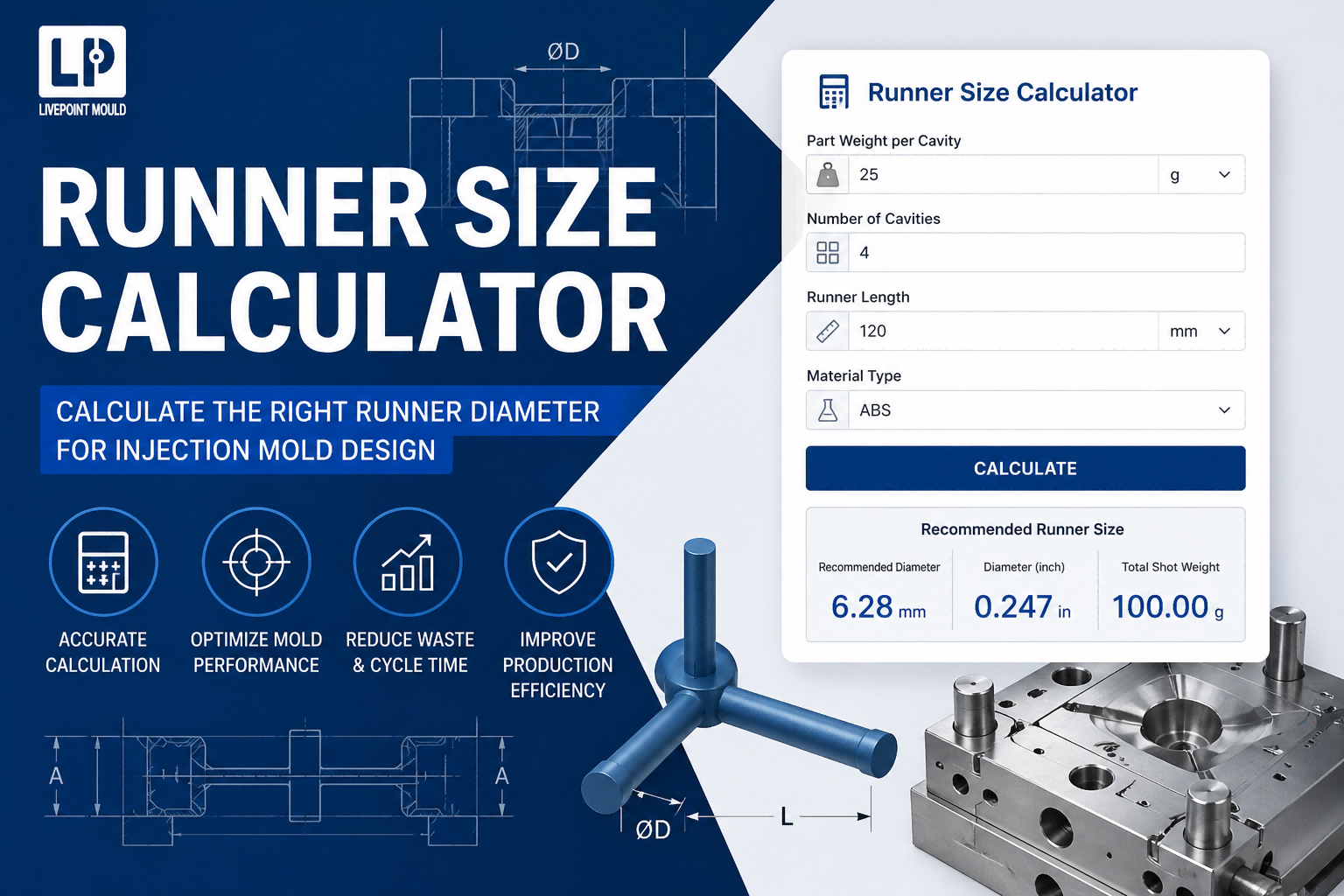
Our Runner Size Calculator helps quickly estimate the right runner diameter for your injection mold project.
Use it to:
- Calculate runner size
- Improve runner design decisions
- Reduce trial-and-error
- Optimize mold performance
Try the calculator above to get started.
What Is a Runner Size Calculator?
A Runner Size Calculator is a tool used to estimate the proper runner diameter in an injection molding system.
It helps determine a runner size capable of:
- Delivering sufficient melt flow
- Reducing pressure loss
- Maintaining cavity balance
- Minimizing material waste
- Improving molding efficiency
Rather than relying solely on guesswork or conservative overdesign, a runner diameter calculator provides a faster and more consistent starting point.
For mold designers, processors, and buyers evaluating tooling designs, it can significantly improve early-stage decision-making.
Why Runner Size Calculation Matters
Runner sizing directly affects molding performance.
- If the Runner Is Too Small
Undersized runners may cause:
- Short shots
- Incomplete filling
- High injection pressure
- Flow hesitation
- Poor cavity balance
This becomes even more problematic in multi-cavity molds.
- If the Runner Is Too Large
Oversized runners can lead to:
- Excess resin consumption
- Longer cooling times
- Larger sprue and runner scrap
- Higher cycle costs
- Reduced production efficiency
Proper runner size is about finding the balance between flow performance and efficiency.
That’s where a runner size calculator becomes valuable.
How a Runner Size Calculator Works
A typical runner size calculation uses several key inputs.
1. Part Weight
Heavier parts generally require larger runners to maintain adequate flow.
Higher shot volume means more material must move through the runner system.
2. Number of Cavities
As cavity count increases:
- Flow balancing becomes more critical
- Pressure loss rises
- Runner dimensions may need to increase
A 16-cavity mold often requires different runner sizing than a 2-cavity tool.
3. Runner Length
Longer runners increase:
- Pressure drop
- Shear resistance
- Heat loss
Long flow paths usually require larger runner diameters.
4. Material Type
Material viscosity significantly affects runner sizing.
Examples:
Low-viscosity materials:
- PP
- PE
- PS
Higher-viscosity materials:
- PC
- Nylon
- Filled engineering plastics
More viscous materials often need larger runners.
Basic Runner Size Formula
A common estimate used in a Runner Size Calculator is:
Runner Diameter ≈ 1.2 × ∛(Shot Weight × Runner Length ÷ 100)
This provides an initial guideline for runner diameter.
Actual production molds may require further refinement through simulation or mold flow analysis.
Example Runner Size Calculation
Suppose:
- Part weight = 30 g
- 4 cavities
- Runner length = 150 mm
Total shot weight:
30 × 4 = 120 g
Estimated runner diameter:
1.2 × ∛(120 × 150 ÷100)
Recommended runner size is approximately 6–7 mm.
Using a runner diameter calculator makes this process much faster.
How to Use Our Runner Size Calculator
Using the calculator is simple.
Step 1 — Enter Part Weight
Input the part weight per cavity.
Use grams or ounces depending on your preference.
Step 2 — Input Number of Cavities
Enter total cavities in the mold.
This impacts overall shot volume and runner balance.
Step 3 — Select Material Type
Choose the molding material.
The calculator adjusts for different material flow characteristics.
Step 4 — Enter Runner Length
Input estimated runner length.
Longer runners generally require larger diameters.
Step 5 — Calculate Recommended Runner Size
The calculator generates:
- Recommended runner diameter
- Total shot weight
- Estimated runner size in mm and inches
Use this as a design starting point.
Standard Runner Size Guidelines
Typical runner sizes often fall within these ranges:
| Part Weight | Suggested Runner Diameter |
|---|---|
| Under 10 g | 3–4 mm |
| 10–50 g | 4–6 mm |
| 50–150 g | 6–8 mm |
| 150 g+ | 8 mm+ |
These are general guidelines and should be verified based on part geometry and material.
Factors That Affect Runner Size
Even with a runner size calculator, several factors influence final sizing.
Material Viscosity
Higher-viscosity materials often require:
- Larger runners
- Higher pressure
- Improved flow balance
Part Geometry
Thin-wall parts may require larger runners than part weight alone suggests.
Wall thickness changes flow behavior.
Multi-Cavity Balance
Family molds and high-cavitation tools often need balanced runner design, not just larger runners.
Cycle Time Goals
Larger runners improve flow but may increase cooling time.
There is always a tradeoff.
Common Runner Sizing Mistakes
- Oversizing “For Safety”
Many molds are overbuilt with oversized runners.
This increases:
- Resin waste
- Cycle time
- Scrap cost
Often unnecessarily.
- Ignoring Material Flow Properties
Using the same runner size for PP and glass-filled nylon can cause major problems.
Material matters.
- Using Weight Alone
Part weight helps, but runner length, cavities, and geometry must also be considered.
That’s why a runner size calculator uses multiple inputs.
Runner Size Calculator vs Mold Flow Analysis
Runner Size Calculator
Best for:
- Preliminary sizing
- Concept design
- Quoting stage
- Fast estimates
- Standard molds
Mold Flow Analysis
Best for:
- Complex geometries
- High-cavity tools
- Tight tolerances
- Critical balance requirements
The calculator gives a strong starting point.
Mold flow validates and optimizes the final design.
Used together, they work best.
Tips for Better Runner Design
To improve performance:
Keep Runner Paths Balanced
Equal flow paths improve filling consistency.
Use Full-Round Runners When Possible
Full-round runners usually provide:
- Better flow efficiency
- Lower pressure drop
- Less material use
Avoid Oversized Cold Runners
Bigger is not always better.
Optimize, don’t oversize.
Validate with Processing Data
Use actual pressure and fill results to refine runner dimensions.
Real-world validation matters.
Frequently Asked Questions
Q1: How do I calculate runner size in injection molding?
Use a runner size calculator based on part weight, cavity count, runner length, and material flow characteristics.
Q2: What is the standard runner diameter?
Typical diameters range from 3 mm to 8 mm, depending on application.
Q3: Does material type affect runner sizing?
Yes. Higher-viscosity materials often require larger runner diameters.
Q4: Can a runner size calculator replace mold flow analysis?
No. It provides a starting estimate, while mold flow is used for optimization and validation.




 English
  Chinese
  German
  Italian
  Spanish
  French
  Russian
  Arabic
  Japanese
  Korean